

🧠 Brains, BCIs & what's next in Neurotech
Join us online next Tuesday!
Happy Friday friends,
It's been a big week.
But to close it out - your brain is about to get rewired (in a good way)!

Neurotech seems to be THE hot topic as of late - AI models predicting treatments, billion dollar valuations, and BCIs are trending like mRNA vaccines during COVID. But most of us only hear about it through headlines.
So we thought it’s a good moment to round up some insanely smart people doing the hard work in the field go straight to the source.
🧠 Join us next Tuesday for a virtual showcase featuring local & global Neurotech companies
This one is one of our What the Health Private Community events - but sharing is caring and this is just too good to miss….
So we’re opening it up to you lovely paid subscribers too 💜
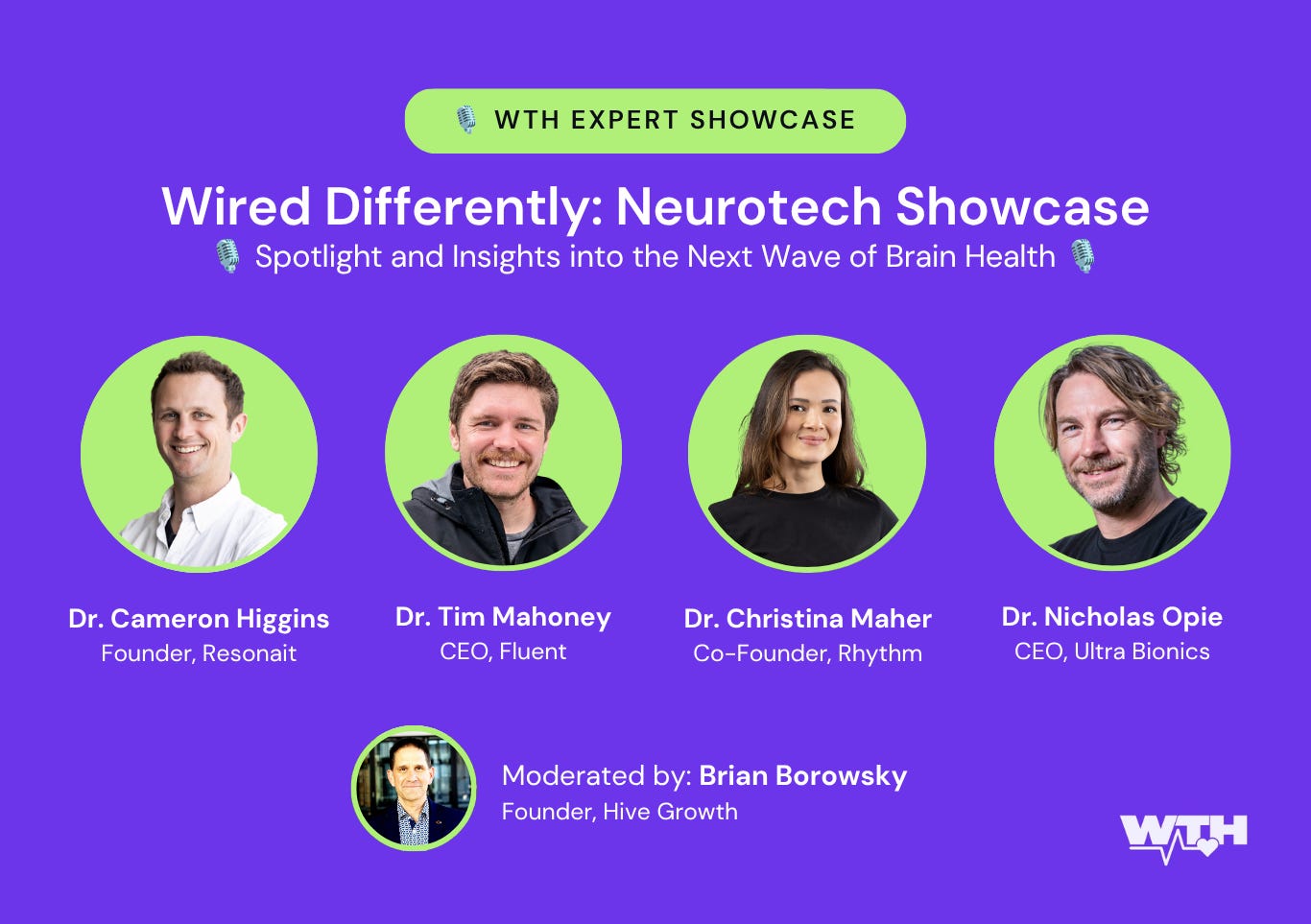
Each founder will walk us through what they’re building, the problem they set out to solve, and what they’ve learned along the way, with live Q&A after each session.
Whether you’re curious about where Neurotech is heading, working in the space yourself, or just want to hear directly from the people building it, this is a chance to get a closer look.
📅 Tuesday, August 4th
⏰ 12.00pm AEST
📍ZOOM*
*you’ll get added to the event if you’re a paid subscriber
🧠 Our Amazing Speakers
🔊 Dr. Nicholas Opie
~ CEO at Ultra Bionics and Founding Director at Synchron
Dr. Nicholas Opie is the guy who put a brain-computer interface inside a blood vessel. His first company, Synchron, built the Stentrode, an implant that lets paralysed patients control digital devices with their thoughts, delivered through the vascular system instead of open-skull surgery. It’s since raised over $300M and let an ALS patient tweet using nothing but their mind.
Now, he’s doing it again with Ultra Bionics, the company he founded to tackle deep brain neuromodulation from a completely different angle: high-resolution, steerable ultrasound. Instead of wiring electrodes into the brain, Ultra Bionics is building implants that can target deep-brain regions with sound, aiming to treat conditions like Parkinson’s disease.
Nick is also Head of the Vascular Bionics Laboratory at the University of Melbourne, holds over 90 patents, and advises other neurotech companies as they scale. Expect him to speak to what it actually takes to found a second deep-tech neurotech company after already building one category-defining one, and why he thinks ultrasound might be the next big unlock for brain disorders that have been notoriously hard to treat.
💻 Dr. Tim Mahoney
~ Co-Founder at Fluent
Tim Mahoney is a biomedical engineer whose work challenges a long-standing assumption in the field: that capturing brain signals precise enough for speech decoding require highly invasive electrodes implanted inside the skull. That work became the foundation for Fluent, the University of Melbourne spinout he co-founded and now leads as CEO.
Fluent is building a brain-computer interface to help people with conditions like motor neurone disease and MS speak again using only their thoughts. The company has recently raised over $2M and has run mentors through the university’s TRAM accelerator, including Synchron CEO Tom Oxley.
Expect Tim to speak to what it takes to build a less invasive alternative in a BCI race dominated by fully implanted devices, and why he thinks sub-scalp is the more realistic path to getting this technology into people’s lives sooner.
🔬 Dr. Christina Maher
~ Co-Founder at Rhythm
Christina is a neuroscientist and biomedical engineer who previously founded Brainland (acquired), and has spent her career building predictive models and precision devices to help people manage their brain health. She holds a PhD in neural engineering and was named a Superstar of STEM by Science and Technology Australia in 2022 as a recognition for scientists working to make emerging tech more publicly understood.
She’s now co-founder of Rhythm, a wearable that turns biosignals into insight, identity and action. Expect her to unpack what’s actually changing in the wearable neural interface space right now, from how these devices are being applied to human communication through to real-time brain state monitoring, and what it takes to build brain health tech people can wear and use day to day, rather than something confined to a clinic.
🔎 Dr. Cameron Higgins
~ Founder at Resonait
Dr. Cameron Higgins spent his PhD and post-doc at Oxford mapping the oscillatory patterns that keep healthy brain networks running, and how those patterns break down in people with depression. He’s now applying that research directly through Resonait, home-deployable neurotech built to reach the millions of people currently on depression treatment waitlists, designed to work alongside the psychologists already treating them, not replace them.
Cam is also an Honorary Research Scientist at Oxford. Expect him to speak to what it takes to turn years of brainwave research into something patients can actually use at home, and why he thinks the depression treatment crisis needs new hardware, not just more therapists.
Upgrade to paid to get your spot!
If this isn’t for you - of course, as always, we still love you and will be back with the newsletter soon ☺️
🎙️ PS - In case you somehow missed it, if you haven’t already checked out Episode 1 of our new podcast…
Chuck it on in the background to help get you through your Friday
(you can even count it as “work”)
Or if you prefer Audio
📺 Youtube | 🍏 Apple | 🎧 Spotify
Thats all for today. See you soon!
👋 Emily & Team WTH